
Dear Members:
Before I get into this month’s newsletter, I want to start with a sincere thank you to everyone who responded to our Call to Action last month and contacted their U.S. representative in support of the National Association for Proton Therapy’s effort to protect access to proton therapy. Many of you told me you sent the prepared message, and quite a few took the extra time to write personal letters of your own. That’s exactly what makes this group so special. When something threatens access to proton therapy for future patients, BOB members show up. Thank you, and we’ll keep you updated on what we learn.

On a completely different note, I made a quick long weekend trip to Montana and Yellowstone last month, and I’m still not sure I have the words to describe it. I’ve traveled to some beautiful places, but Yellowstone was unlike anything I've ever seen.
And Montana itself surprised me. I don’t remember seeing much that even resembled a highway. We drove for miles on long, winding roads with mountains in every direction and hardly another person in sight. Coming from just outside of Boston, Massachusetts, where you can barely drive a mile without hitting traffic, a Dunkin’ or a traffic round-about designed by someone who clearly hates humanity, it was a little surreal.
We spent some time in Big Sky, where my husband, Mark, has been going on a ski trip every year for years with our neighbor and a group of friends. I’ve spent all those years at home imagining him inching his way across some narrow, rocky ledge, one wrong move away from sailing off the side of the mountain — all this so he can get to a 50-degree trail of death that apparently looks like “fun” to him. After finally seeing Big Sky in person, I can report that I have not been overreacting. If anything, I haven’t been worried enough. The mountain is basically an enormous pile of rocks that comes to a point approximately 12,000 feet in the sky. And Mark skis down it. Voluntarily.
Fortunately, there was no skiing for us. It was about 70 degrees and sunny during the day — and then one night it snowed. So apparently Montana has absolutely no idea what season it is. But I don’t hate it. The air is so dry I wore my hair down the entire trip. No humidity. No frizz. Honestly, we could’ve skipped Yellowstone and I still would’ve given Montana five stars just because of my hair.

We saw an elk and a bison standing right along the side of the road, drove through scenery that didn’t even look real, and walked past ground that was literally bubbling, steaming and occasionally shooting boiling water into the air — which is apparently a perfectly normal thing to happen at Yellowstone. We saw parts of this country that reminded me just how enormous and wildly different it is from one place to another. You can spend your whole life in our beautiful country and still stumble across places that feel like another world, an undiscovered planet
That idea seems especially fitting for this month’s BOB Tales. We’re looking at some things that would have sounded pretty far-fetched not all that long ago — a scan that may one day help some men avoid a prostate biopsy and a drug that recruits the body’s own cells to attack prostate cancer. There’s also evidence that something as simple as standing on one leg may tell us something about how long we’ll live. And just for fun, there’s a hydrogen car that can go nearly 500 miles and NASA’s new supersonic jet that could transform air travel.
And, as always, there’s so much more in this issue — including the fourth and final part in our NCCN prostate cancer guidelines series, this time covering the many treatment options available after a prostate cancer diagnosis and how doctors determine which approach may be right for each patient.
And be sure to read the “Final Thought” at the very end. It’s about two young people whose lives took devastating turns on the very same day, at the very same hospital, and eventually led somewhere neither of them could possibly have imagined.
Maybe that’s another good reminder to keep exploring, keep learning and keep looking ahead. There’s still an awful lot out there we haven't even imagined yet.
Questions? Thoughts? Feedback? Send me an email: [email protected].
We hope you enjoy this month’s issue, and as always, thank you for being part of the BOB community.
Deb Hickey

📄 Prefer to print and read?
👉 Download the PDF here.

- Could a Simple Scan Help Men Avoid Prostate Biopsies?
- Powerful Prostate Cancer Treatment Can Now Be Used Even Earlier
- New Drug Harnesses Immune System to Attack Prostate Cancer
- Study Links Dietary Fat Choices to Survival After Prostate Cancer
- Special Segment: Making Sense of Prostate Cancer — Part 4: From Risk Group to Treatment
- Want to Live Longer? Work on Your Balance
- Cholesterol and Aging: Know Your Numbers
- Spike in Bed Bugs: Check Before You Unpack

Could a Simple Scan Hep Men Avoid Prostate Biopsies?
Back in May, we reported on research suggesting that PSMA-PET/CT imaging could help some men avoid unnecessary prostate biopsies. A new study from researchers at the Medical University of Vienna adds more evidence that this powerful imaging technology may have a role much earlier in the prostate cancer diagnostic process.
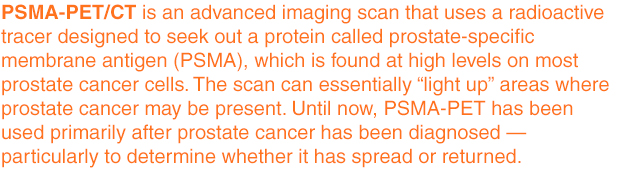
The analysis included 194 men enrolled in the Phase 3 RAPID trial with elevated PSA levels and suspected prostate cancer. Among the 77 men ultimately found to have clinically significant prostate cancer, PSMA-PET/CT correctly identified 70 — a detection rate of 91%. And when the scan was negative, there was a 91% chance that clinically significant prostate cancer was not present.
Researchers also followed the men for a median of 35 months. Of the 24 patients who went on to have an aggressive course of disease, 23 had already been identified by PSMA-PET/CT.

These findings build on the research we reported earlier this year. That study looked at whether PSMA-PET/CT could help men with inconclusive or low-risk MRI findings avoid biopsy. This latest research provides additional evidence that PSMA-PET/CT may eventually help doctors determine which men with suspected prostate cancer truly need a biopsy.
This doesn’t mean prostate biopsies are going away anytime soon. PSMA-PET/CT isn’t a replacement for biopsy, and some prostate cancers don’t express enough PSMA to be reliably detected by the scan. More research will be needed before this approach becomes part of routine prostate cancer diagnosis.
Still, the direction of the research is encouraging. A technology once used primarily after a prostate cancer diagnosis is increasingly being studied before diagnosis — with the possibility that someday, some men may be able to safely avoid an invasive biopsy altogether.


Powerful Prostate Cancer Treatment Can Now Be Used Even Earlier
The FDA recently expanded the use of Pluvicto (lutetium Lu 177 vipivotide tetraxetan) for certain men with PSMA-positive metastatic hormone-sensitive prostate cancer (mHSPC) — advanced prostate cancer that has spread but is still responding to hormone therapy. That's significant because this PSMA-targeted radioligand therapy, which we first wrote about in May 2021, can now be used earlier in the course of the disease.

The expanded approval was based on the Phase III PSMAddition trial, which included 1,144 men with PSMA-positive mHSPC. Participants received either Pluvicto plus an androgen-receptor pathway inhibitor (ARPI), a drug that blocks the effects of male hormones that can fuel prostate cancer, or an ARPI alone. Adding Pluvicto reduced the risk of the cancer worsening or spreading, as detected on imaging scans, or death by 28%.
Researchers don’t yet know whether adding Pluvicto will help men live longer because the study hasn’t been underway long enough to answer that question. But the results showing that Pluvicto slowed disease progression were strong enough for the FDA to expand its approval.
This is particularly interesting because Pluvicto has steadily become available earlier in prostate cancer care. It was initially approved in 2022 for heavily pretreated metastatic castration-resistant prostate cancer (mCRPC). In 2025, the FDA expanded its use to certain men with mCRPC before chemotherapy. Now, in 2026, its reach has expanded again — this time into metastatic hormone-sensitive disease.
For eligible men, a treatment once reserved for much later in the course of advanced prostate cancer is now available substantially sooner.
New Drug Harnesses Immune System to Attack Prostate Cancer
Researchers are testing a promising new immunotherapy drug called pasritamig in two advanced clinical trials. The trials involve men with metastatic prostate cancer that no longer responds to hormone therapy.

Here’s what makes it interesting: Immunotherapy has generally not worked nearly as well in prostate cancer as it has in several other cancers. Pasritamig takes a different approach. One part of the drug attaches to KLK2, a protein found almost exclusively in prostate tissue, including prostate cancer cells. The other attaches to a patient’s T cells — immune cells capable of killing cancer. In simple terms, the drug acts like a bridge, connecting immune cells to prostate cancer cells so the immune cells can attack the cancer.
Pasritamig has already shown encouraging results in early testing. In a Phase I trial, 42% of patients had their PSA drop by at least half. Just 9% of patients experienced cytokine release syndrome, a potentially serious immune reaction associated with this type of treatment, and all of those cases were mild.
Researchers are now testing pasritamig in two Phase III trials. One is comparing pasritamig plus chemotherapy with chemotherapy alone. The other is studying pasritamig in men with advanced prostate cancer who’ve already received several other treatments. These larger trials should provide a much clearer picture of how well the drug works and whether it can improve outcomes for men with advanced disease.
Pasritamig is not yet FDA-approved, but the early results are encouraging — particularly for a cancer that has historically been difficult to treat with immunotherapy.
Study Links Dietary Fat Choices to Survival After Prostate Cancer
What men eat after a prostate cancer diagnosis may have an important impact on how long they live, according to a new study published in JAMA Network Open.
Researchers followed 4,884 men with nonmetastatic prostate cancer for a median of nearly 13 years, looking specifically at the types of fat they consumed after diagnosis.
Men who ate the most saturated fat — found largely in foods such as red meat, butter, cheese and other full-fat dairy products — had a 24% higher risk of dying from any cause compared with those who ate the least. Interestingly, the increased risk wasn’t from prostate cancer itself. It was driven primarily by deaths from cardiovascular disease and other cancers.

The researchers also found encouraging evidence that what men eat instead of those fats may make a difference. Replacing some animal fats with plant-based fats — found in foods such as olive oil, avocados, nuts and seeds — was associated with a 16% lower risk of death. Replacing some saturated fats with monounsaturated fats, another type of healthier fat found in many of those same foods, was associated with a 20% lower risk.
The study doesn’t prove that saturated fat caused the higher death rate. It was an observational study, meaning researchers tracked what men ate and what happened to them rather than assigning them specific diets. Still, with nearly 4,900 prostate cancer patients and almost 13 years of follow-up, the findings add to growing evidence that diet can play an important role in long-term health after prostate cancer.
For men living many years after a prostate cancer diagnosis, taking care of the heart and the rest of the body may be every bit as important as keeping an eye on the cancer.

Making Sense of Prostate Cancer
The National Comprehensive Cancer Network (NCCN) is one of the world’s leading authorities on cancer care. Its evidence-based clinical practice guidelines help physicians make informed decisions about cancer screening, diagnosis, and treatment. NCCN also publishes patient-friendly versions of these guidelines to help individuals and families better understand each step of the journey.
Over the past three months, we’ve been working our way through the prostate cancer journey using the latest NCCN Guidelines for Patients: Early-Stage Prostate Cancer, 2026. We began with PSA screening and early detection, then explored what may happen after an abnormal PSA result, including MRI scans and prostate biopsies. Last month, we looked at what happens after prostate cancer is diagnosed—breaking down Gleason Scores, Grade Groups, clinical stage, and other important biopsy findings.
This month, we’re putting it all together. Building on the risk groups we introduced last month, we’ll look more closely at how your PSA level, Grade Group, clinical stage, and other findings work together to define your individual risk—and, most important, how that information is used to help determine whether treatment is needed and which treatment options may be most appropriate.
The important thing to remember is that no single number tells the whole story. A PSA of 8, a Grade Group of 2, or a clinical stage of T2 means something very different when considered alone than when combined with the rest of a patient’s information. That complete picture—not any one test result—is what helps patients and their physicians
make informed treatment decisions.
In this final installment, our goal is to connect the dots: from diagnosis and risk classification to the treatment decisions that follow.

Part 4: From Risk Group to Treatment
Last month, we looked at the key pieces of information doctors use to assess prostate cancer, including PSA level, Gleason Score, Grade Group, clinical stage, and other biopsy findings. We also introduced the NCCN risk groups, which bring these findings together to help estimate how likely a cancer is to grow or spread.
But knowing your risk group raises the next—and perhaps most important—question: What does it mean for treatment?
NCCN treatment recommendations are based on more than simply whether prostate cancer is present. A cancer that appears unlikely to grow or spread may not need immediate treatment at all, while a higher-risk cancer may warrant more intensive treatment or a combination of therapies.
Once the cancer has been assessed, physicians also consider factors unique to the patient—including age, overall health, life expectancy, other medical conditions, and personal preferences. These factors don’t determine the risk group, but they can play an important role in deciding which treatment approach is most appropriate.
In this final installment, we’ll put it all together: how the characteristics of the cancer determine its risk group, what that risk group means for treatment, and how physicians and patients use all of this information to make an individualized treatment decision.
How Your Risk Group Is Determined
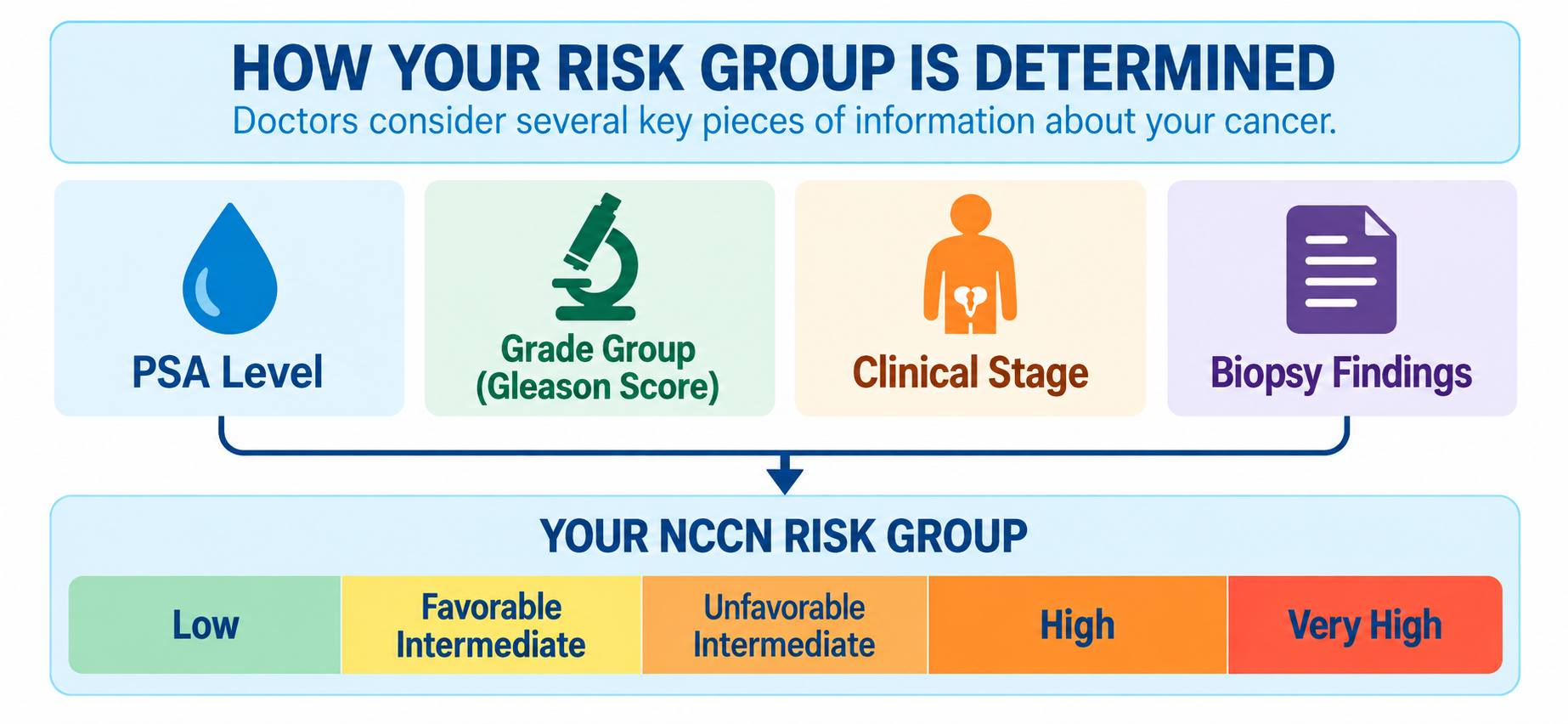
As we discussed last month, no single test result tells the whole story. After prostate cancer is diagnosed, doctors look at several characteristics of the cancer together to determine its risk group. The most important include:
- PSA level — How much prostate-specific antigen is in the blood
- Grade Group/Gleason score — What the cancer cells look like under the microscope and how aggressive they appear
- Clinical stage — How far the cancer appears to have grown based on the physical exam, biopsy, and imaging when appropriate
- Biopsy findings — How much cancer was found, including the number of biopsy cores containing cancer and, in some cases, how extensively those cores are involved
These findings are considered together to place the cancer into one of five NCCN risk groups: low, favorable intermediate, unfavorable intermediate, high, or very high risk.
When the Findings Don't All Match
Here’s where it can get confusing: your PSA, Grade Group, and clinical stage don’t necessarily point to the same risk level. A low PSA, for instance, doesn’t necessarily mean low-risk prostate cancer if the biopsy shows a more aggressive Grade Group. Likewise, a lower Grade Group may not tell the whole story if the cancer has grown beyond the prostate. It’s the combination of these findings—and, important, the presence of higher-risk features—that determines the risk classification.
That’s why two men with prostate cancer can have very different risk classifications—and ultimately very different treatment recommendations.
How Risk Group Helps Guide Treatment
Once your risk group has been determined, it becomes an important starting point for deciding how the cancer should be managed. But your risk group does not automatically determine one specific treatment. Depending on the characteristics of the cancer, there may be several appropriate options. These can range from active surveillance for some lower-risk cancers to surgery, radiation therapy, hormone therapy, or combinations of treatments for cancers with higher-risk features.
And this is where the patient becomes an important part of the equation. Age, overall health, life expectancy, other medical conditions, potential side effects, and personal preferences can all influence which of the appropriate options makes the most sense for an individual man.
When Treatment May Not Be Necessary
For some men with early-stage prostate cancer, immediate treatment may not be necessary. Instead, the cancer can be monitored through active surveillance, allowing men to avoid—or delay—the potential side effects of treatment.
Active surveillance involves regular PSA tests, clinical exams, MRI scans, and repeat biopsies. If the cancer shows signs of progressing, treatment can begin. Many men on active surveillance never need treatment.
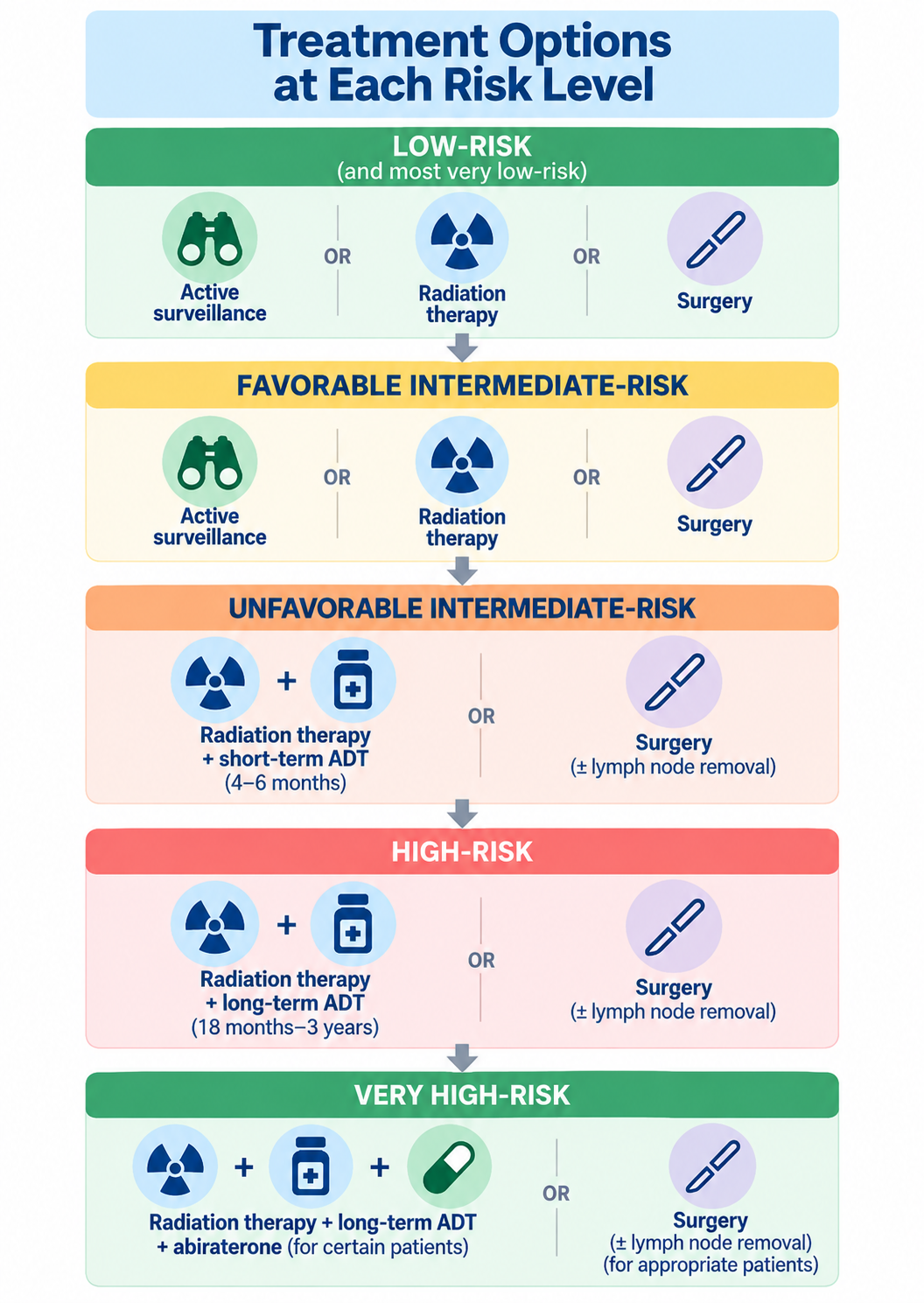
For men with low-risk prostate cancer and a life expectancy of 10 years or more, active surveillance is NCCN's preferred strategy. For those with a life expectancy of fewer than 10 years, NCCN generally recommends observation, which involves less intensive monitoring. Active surveillance may also be appropriate for some men with favorable intermediate-risk disease.
Treatment Options at Each Risk Level
As risk increases, the treatment options generally change. But even within the same risk group, there may be more than one appropriate approach. Life expectancy, overall health, the specific features of the cancer, and a man’s preferences all help shape the decision.
For favorable intermediate-risk prostate cancer, men with a life expectancy of 10 years or more may have several options, including active surveillance, radiation therapy, or surgery. Active surveillance is generally reserved for carefully selected men whose cancers have more favorable features.
With unfavorable intermediate-risk disease, treatment typically becomes more intensive. For men with a life expectancy of 10 years or more, NCCN recommends either surgery or radiation therapy combined with a short course of hormone therapy, also called androgen deprivation therapy (ADT).
For high- and very high-risk prostate cancer, treatment is generally more aggressive. Options can include radiation therapy combined with longer-term hormone therapy or surgery for appropriate patients. For certain men with very high-risk disease, NCCN also includes abiraterone (Zytiga), a medication that further reduces the body’s production of male hormones that can fuel prostate cancer, given along with radiation and hormone therapy.
Understanding the Main Treatment Options
Each treatment approach comes with its own potential benefits, side effects, and impact on quality of life. Understanding these differences can help patients weigh their options and have more informed conversations with their doctors.
The NCCN guidelines outline several approaches for managing or treating early-stage prostate cancer. Depending on a man’s risk group, overall health, and life expectancy, these may include active surveillance, observation, surgery, radiation therapy, and, for some men, hormone therapy. Each of these approaches may include additional treatment options or techniques.
- Active surveillance — The cancer is monitored closely with PSA tests, exams, MRI scans, and repeat biopsies, with treatment started if the cancer shows signs of progressing.
- Observation — A less intensive form of monitoring, generally used when prostate cancer is unlikely to cause problems during a man’s lifetime.
- Surgery (Radical prostatectomy) — The prostate, seminal vesicles, and surrounding tissue are removed, along with nearby lymph nodes in some cases.
- Open prostatectomy — through a single larger incision.
- Minimally invasive/robot-assisted prostatectomy — through several small incisions, usually with the surgeon controlling a robotic system.
- Radiation Therapy — Radiation can be delivered in several ways:
- External beam radiation therapy (EBRT) — radiation delivered from a machine outside the body.
- Stereotactic body radiation therapy (SBRT) — a highly precise form of EBRT typically delivered in five treatments.
- Proton beam therapy — a form of EBRT that uses protons rather than
X-rays. - Brachytherapy — radiation placed inside or next to the prostate.
- Low dose-rate (LDR) brachytherapy — radioactive seeds are permanently implanted.
- High dose-rate (HDR) brachytherapy — radioactive sources are temporarily placed in the prostate.
- Hormone therapy (ADT) — Androgen deprivation therapy lowers testosterone or blocks cancer cells from using it and is often combined with radiation for higher-risk disease.
For more detailed information about each of these approaches, including how they’re performed, potential side effects, and other considerations, see Chapter 5, “Types of Treatment,” beginning on page 35 of the 2026 NCCN Guidelines for Patients: Early-Stage Prostate Cancer.
How Do You Choose Among the Options?
When more than one treatment is considered appropriate, there may not be a single “right” choice. The decision often comes down to balancing how the cancer is likely to behave with the benefits and potential side effects of each treatment — and deciding what matters most to the patient.
Age, overall health, life expectancy, and other medical conditions all play a role. So do quality-of-life considerations. Surgery, radiation therapy, and hormone therapy can affect men differently, with potential effects on urinary, bowel, and sexual function. Hormone therapy can also cause side effects such as hot flashes, fatigue, loss of muscle mass, and changes in bone health.
Personal priorities matter, too. One man may be most concerned about avoiding a particular side effect, while another may place greater importance on completing treatment as quickly as possible or choosing a less invasive approach. Some men may feel comfortable with active surveillance; others may find the idea of living with an untreated cancer difficult.
This is why shared decision-making is so important. Patients should understand not only which options are appropriate for their cancer, but why they’re appropriate, what the potential trade-offs are, and how each choice may affect their lives.
Questions to Ask Your Doctor
Treatment appointments can cover a lot of information in a short amount of time, so it helps to arrive prepared. Bring a written list of questions and take notes. If possible, bring your spouse, partner, family member, or friend for a second set of ears. You might also ask your doctor if you can record the conversation so you can listen to it again later.
Here are some questions to consider asking:
- What is my NCCN risk group, and what specifically puts me in that group?
- Which treatment options are appropriate for me—and why?
- Is active surveillance an option for me?
- What are the potential urinary, bowel, and sexual side effects of each option?
- Will I need hormone therapy? If so, for how long?
- How might my age, overall health, and life expectancy affect my choices?
- How much experience do you have treating men with my particular diagnosis?
- Can you connect me with former patients who underwent this treatment and are willing to speak with me?
Putting it All Together
Over the past four months, we’ve followed the prostate cancer journey from the very beginning: when and why to consider PSA screening, what may happen after an abnormal result, how a diagnosis is made and understood, and finally, how all of that information helps guide treatment decisions.
If there’s one lesson we hope readers take away from this series, it’s that prostate cancer is rarely defined by a single number or test result. PSA, Gleason score and Grade Group, clinical stage, other biopsy findings, risk group, overall health, life expectancy, and personal priorities all contribute to the bigger picture.
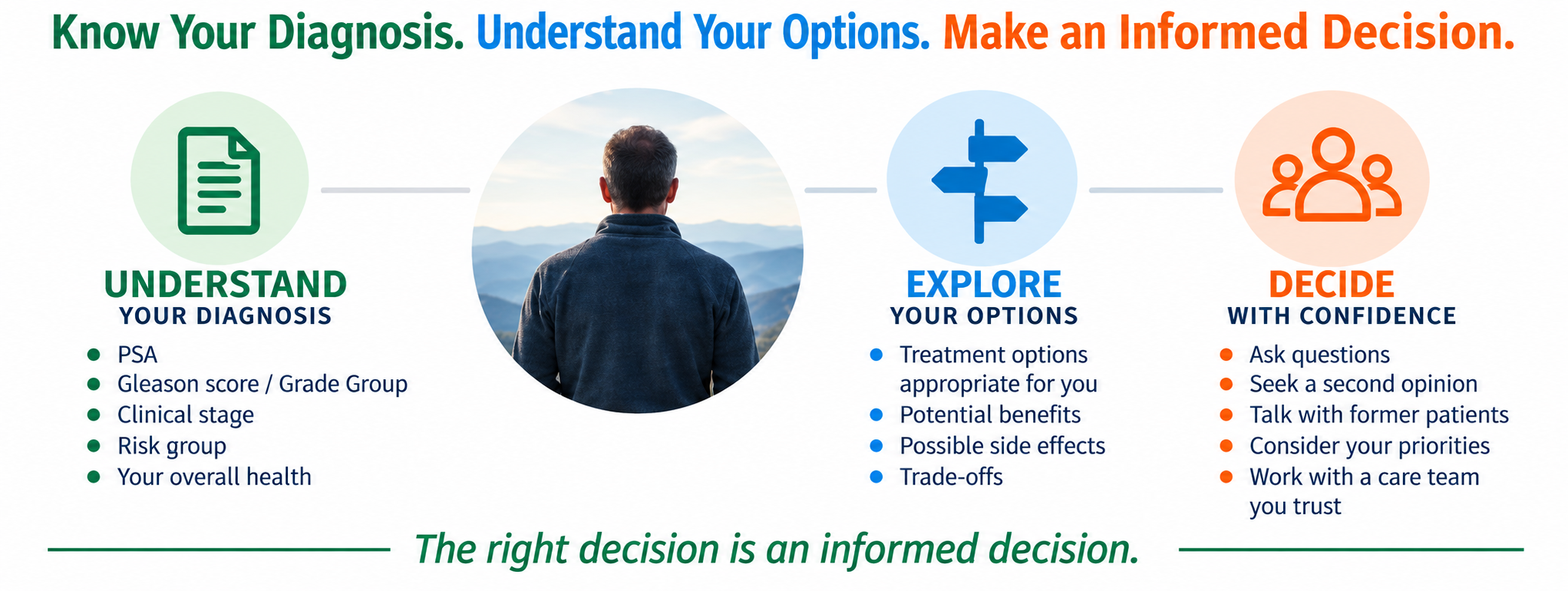
And perhaps most important, being diagnosed with prostate cancer doesn’t mean you need to make a treatment decision overnight. Take the time to understand your diagnosis. Ask questions. Seek opinions from specialists in different disciplines. Talk with men who have undergone the treatments you’re considering. Learn about the benefits and potential trade-offs of every option that’s appropriate for you. Then make the decision that feels right for you, armed with good information and the guidance of physicians you trust.

Want to Live Longer? Work on Your Balance
Staying active as we age is important. Walking, exercising, and strength training can all help us stay healthy and independent. But there’s another part of fitness that’s easy to overlook — balance. And new research suggests it may be more important to longevity than many of us realize.

A large study followed 13,423 adults age 65 and older for a median of seven years. Researchers tested cardiovascular fitness, muscle strength, flexibility, balance, and agility. Balance was measured by standing on one leg, while agility was measured by timing how quickly participants could rise from a chair, walk eight feet, return, and sit down.
The results were striking. Balance and agility had the strongest association with a lower risk of death, followed by lower body strength and cardiovascular fitness. In general, the better people performed on these fitness tests, the lower their risk.
That’s a good reminder that healthy aging isn’t just about getting your steps in. Maintaining strength and balance can help us stay mobile, reduce the risk of falls, and keep doing the things we enjoy. And you don’t necessarily need a gym to work on either one.
Simple exercises such as repeatedly standing up from a chair, practicing standing on one leg, climbing stairs and doing basic resistance exercises can help maintain lower-body strength and balance.
It’s important to note that this study found an association — it doesn’t prove that better balance itself makes you live longer. People with better balance and strength may also be healthier in other ways. Still, the findings reinforce an important message: don’t just keep moving — work on staying strong and steady, too.
Cholesterol and Aging: Know Your Numbers
A recent USA TODAY article, republished by Yahoo Health, explains how cholesterol levels can change throughout life and why monitoring them is important for long-term cardiovascular health.
Cholesterol is a waxy substance the body needs to build cells and produce hormones. But too much low-density lipoprotein (LDL), often called “bad cholesterol,” can contribute to plaque buildup in artery walls, increasing the risk of heart attack and stroke.
Because high cholesterol usually causes no symptoms, a blood test is the only way to know your levels. And age matters. LDL levels tend to rise through middle adulthood. In men, LDL generally increases until around age 60 and then may gradually decline. Women typically have lower levels than men earlier in adulthood, but cholesterol often rises after menopause as estrogen levels decline.
A standard lipid panel measures LDL, high-density lipoprotein (HDL, or “good cholesterol”), triglycerides and total cholesterol. General reference levels include:
- LDL: Below 100 mg/dL is considered optimal for many adults, although lower targets may be recommended for people at higher cardiovascular risk.
- HDL: At least 40 mg/dL for men and 50 mg/dL for women is generally considered healthy.
- Triglycerides: Below 150 mg/dL is considered normal.
- Total cholesterol: Below 200 mg/dL is generally considered desirable.
An LDL level of 190 mg/dL or higher is considered severely elevated and typically warrants discussion with a physician about treatment. Very high cholesterol, particularly when accompanied by a family history of premature heart disease, may also lead a physician to consider testing for an inherited cholesterol disorder.
Spike in Bed Bugs: Check Before You Unpack
If you think bed bugs are mostly a problem in run-down hotels, think again. The CDC reports a recent rise in infestations worldwide, including in higher-income countries. They’ve been found in homes, hotels — including five-star resorts — cruise ships, buses and trains. Cleanliness has little to do with it.

Bed bugs aren’t known to transmit disease, but their bites can cause itching and skin irritation, and they can be difficult and expensive to eliminate. They don’t fly or jump — they hitch rides home in luggage, clothing and other belongings.
And most of us aren’t looking for them. A 2025 National Pest Management Association survey found that just 28% of Americans check their hotel rooms for bed bugs.
Before You Unpack
The CDC and EPA recommend a few simple precautions:
- Inspect the bed. Check mattress seams, the headboard and nearby furniture for bugs, shed skins or small dark or rusty spots.
- Keep luggage off the bed and floor. Use a luggage rack after inspecting it.
- Keep your suitcase closed when you’re not using it, and don’t leave clothing on beds or upholstered furniture.
- If you find signs of bedbugs, notify hotel management and request another appropriately separate room or different accommodations.
When You Get Home
Inspect your luggage before bringing it into the bedroom and unpack clothing directly into the washer or dryer. Heat is one of the best weapons against bed bugs: The EPA says high temperatures in a clothes dryer can kill them, while washing alone generally will not. If possible, store luggage away from your bedroom rather than under the bed.
If You Bring Them Home
Act quickly. Bed bugs reproduce and spread, and established infestations can be difficult to eliminate. Professional pest control may be necessary; the EPA warns against relying on “bug bombs” or foggers alone.

The Wealth We Keep
A long-time BOB member from Sedona, AZ recently sent
Bob Marckini a quote that beautifully captures the spirit of giving:

It’s a simple thought, but a powerful one. What we accumulate during our lives eventually gets left behind. What we give — our time, our generosity, our encouragement and the ways we help others — can continue making a difference long after the moment has passed.
That’s something we’ve witnessed countless times within the BOB community. And we can’t think of a better reminder of what Giving Back is all about.

Ways to Give
Make a gift online and choose where you’d like it to go:
- Cancer Center Vision / Stronger Together Campaign
- Proton Research – James M. Slater Chair
- Proton Research – Robert J. Marckini Chair
- Other (specify area or write “unrestricted” for greatest need)
Send a check to “LLUCC.” Specify where you’d like to direct your gift in the memo line and mail to: LLUH Office of Philanthropy | P.O. Box 2000 | Loma Linda, CA 92354
Call 909-558-5010 to make a gift or ask questions.

Did It Make a Difference for You?
Over the years, we’ve heard from countless men who discovered You Can Beat Prostate Cancer shortly after hearing the words, “You have prostate cancer.” Many say it helped them understand their treatment options and know what questions to ask. Others say it introduced them to proton therapy or simply gave them confidence to make the decision that was right for them. Some even call it a “life saver.”
Whether you read the first or second edition — and no matter how long ago you read it — if You Can Beat Prostate Cancer played a part in your story, please consider writing a review on Amazon.
Your review doesn’t have to be long or dramatic. A few honest sentences about how the book helped you may be exactly what another man — newly diagnosed, overwhelmed, and unsure what to do next — needs to read as he begins making decisions of his own.

Last Month’s Brain Teaser

Congratulations to Robert G. from Minneapolis, MN! Robert was treated with proton therapy at the former Bloomington, IN proton center and he’s “feeling near perfect for someone in their 80s.” Robert tells us he’s been reading BOB Tales for nearly two decades, and the humor section and Brain Teaser are the first things he reads each month! Robert, we hope you enjoy your prize — a signed copy of Bob Marckini's book, You Can Beat Prostate Cancer.
New Brain Teaser
How many people need to be in a room before there’s a greater than 50% chance that at least two of them share a birthday?
Think you know it? Send us your answer for a chance to win a signed copy of Bob Marckini's second edition of You Can Beat Prostate Cancer — plus a BOB T-shirt!

Bad Humor...
It’s been a bit of a strange day! First I found a hat full of money on the sidewalk. Then I was chased by an angry man with a guitar!

“I didn’t see you at camouflage drill this morning corporal”
“Oh, thank you very much, sir.”
I told my wife she’s bad with directions. She was so mad, she packed her bags and right.
Two penguins walk into a bar… Which is funny, because the second one should have seen it.
Road work ahead? I sure hope it does!
My friend said to me: “What rhymes with orange.”
I said: “No it doesn’t.”
What did the pirate say on his 80th birthday? Aye matey!
Do you know where I can get a toupee?
Not off the top of my head.
Stop hating on lazy people. We didn’t even do anything.
My grief counselor died.
He was so good, I don’t even care.
Why did the old man fall into the well?
Because he couldn’t see that well.
My husband and I have reached the difficult decision that we do not want children. If anybody does, please just send me your contact details and we can drop them off tomorrow.
Option 1: Let’s eat grandma.
Option 2: Let’s eat, grandma.
There you have it. Proof that punctuation saves lives.

Memory Problems
An elderly couple is watching TV one evening when the husband gets up from his chair.
“Want anything while I’m in the kitchen?” he asks.
“I’d love a bowl of ice cream,” his wife says. “Can you remember that?”
“Of course I can,” he replies. “I can remember ice cream.”
“Okay, but put some strawberries on it. You should really write that down.”
“I’ve got it, Ethel! Easy — ice cream with
strawberries.”
“And whipped cream. Definitely jot that down.”
The man sighs. “Ice cream. Strawberries.
Whipped cream. I can remember three things!”
“You say that now...”
“I've got it!” he snaps, and heads into the kitchen.
About 20 minutes later, the man returns carrying
a plate of bacon and eggs and proudly sets it in
front of her.
His wife stares at the plate for a long moment. Then
she looks up at him and says: “Where’s my toast?”

Would You Let AI Be Your Doctor?
It may sound futuristic, but officials in Utah are taking a step in that direction. The state’s Office of Artificial Intelligence Policy, together with the Division of Professional Licensing, has authorized a limited pilot program testing whether AI can safely handle routine prescription renewals.
For now, every AI-recommended renewal must still be approved by a licensed medical professional, but if the program meets safety requirements, certain medications could eventually be renewed by AI without a doctor’s approval.
Meanwhile, researchers are developing AI systems that can review medical records, interpret tests, suggest diagnoses, and recommend treatment plans. But there’s reason for caution: A 2026 Nature Medicine study involving nearly 1,300 people found that using today’s medical chatbots did not improve people’s medical decisions compared with conventional methods.
AI may become an extraordinary tool for physicians. But an AI instead of a physician? We’re not there yet.
500 Miles on Hydrogen — Refuel in Four Minutes
French automaker NamX is developing a hydrogen-powered SUV with an unusual twist: Along with a fixed hydrogen tank, the vehicle carries six removable hydrogen capsules that can be swapped out rather than waiting for the car to recharge. NamX says the system could give the HUV a range of about 497 miles.
The concept could address two major hurdles facing alternative-fuel vehicles — range and refueling time — although hydrogen fueling infrastructure remains limited. NamX is taking pre-orders and says deliveries are planned for late 2028.
NASA’s New Jet: The Future of Air Travel?
Beginning in 1976, the Concorde carried paying passengers across the Atlantic at roughly twice the speed of sound, cutting a New York-to-London trip to about three-and-a-half hours. But tickets were extraordinarily expensive, the aircraft consumed enormous amounts of fuel, and its thunderous sonic boom restricted where it could fly at supersonic speeds. Concorde was retired in 2003.

Now NASA is tackling one of those problems. Its experimental X-59 aircraft is designed to fly faster than the speed of sound while producing a much quieter “thump” instead of a sonic boom. The unusual aircraft is 100 feet long with a wingspan of just 30 feet, carries only one pilot, and is strictly a research plane — it will never carry passengers.
NASA is testing the X-59 in California and ultimately plans to fly it over selected U.S. communities to find out how people on the ground react to the sound. The results will be shared with regulators considering whether current restrictions on civilian supersonic flight over land should be changed.
If NASA can prove supersonic flight doesn’t have to come with a disruptive sonic boom, what it learns could eventually help aircraft manufacturers develop a new generation of quieter, ultra-fast passenger jets.

Sometimes the Hardest Chapters Lead Somewhere Beautiful
In the fall of 2018, 18-year-old Zachary Zarembinski collapsed during a high school football game and suffered a devastating brain injury. Doctors placed him in a medically induced coma and weren’t sure he’d wake up. Nine days later, he did.
That same day, 16-year-old Isabelle Ric hard crashed her Jeep into a tree and was rushed to the same Minnesota hospital campus with a severe brain injury. She, too, was placed in a medically induced coma.
Zach woke after nine days and began making remarkable progress. Isabelle remained unconscious.
Then something happened that neither family could have known would matter years later. Isabelle’s mother heard about Zach’s recovery and went to meet him. Her daughter was lying in a hospital bed, and she was looking for something — anything — that might give her hope. Zach had survived a serious brain injury. Maybe Isabelle could, too.
After spending about two-and-a-half months in a coma, Isabelle finally did wake up and began the long process of relearning how to walk and talk. Zach visited her during her recovery. He remembered her smile. Isabelle, still struggling with the effects of her injury, couldn’t remember meeting him at all. Then their lives went in separate directions.
For years, both concentrated on recovering and rebuilding. Their mothers remained connected on Facebook, but Zach and Isabelle had little contact.
Then, in 2024, Zach saw a post from Isabelle’s mother celebrating how far her daughter had come. He left a comment:
Thank you for sharing her beautiful progress. God does amazing things for great people. Isabelle, your smile shines bright! I pray you continue to stay amazing and fight the good fight!!!
The two families eventually got together for dinner, and Zach asked Isabelle for her phone number. This time, she remembered him.
The two began talking, then dating, and discovered something few other people could completely understand about them: Each knew what it was like to have life suddenly divided into a “before” and an “after.” Each understood the frustration, fear and long road back from a traumatic brain injury.
They fell in love.
In November 2025, Zach brought Isabelle back to Regions Hospital, supposedly to record an episode for the podcast they’d started together about healing. He led her to the very spot where, seven years earlier, he’d first met her frightened mother. And there, he got down on one knee and asked Isabelle to marry him.
She said yes.
On Sept. 4, 2026, Zach and Isabelle were married in Red Wing, MN.
There’s something almost impossible to comprehend about the timing of their story. In 2018, Isabelle’s mother walked through a hospital searching for hope during one of the darkest moments of her life. She found a young man who had survived something remarkably similar to what her daughter was going through. She couldn’t possibly have known that she was also meeting her daughter’s future husband.
We rarely get to see where the most difficult chapters of our lives are leading while we’re living through them. Sometimes all we can see is what’s directly in front of us — the fear, the uncertainty, the thing we desperately wish had never happened.
And then, every once in a while, life lets us look back. Only then can we see that a moment we once would have given anything to erase somehow became the path to something extraordinary.
Low PSAs to all,
Bob Marckini and Deb Hickey
Want a printable version of this issue?
👉 Download the PDF here.
NO MEDICAL ADVICE: Material appearing here represents opinions offered by non-medically trained laypersons. Comments shown here should NEVER be interpreted as specific medical advice and must be used only as background information when consulting with a qualified medical professional.