

Dear Members:
November is here, and with it comes an annual tradition that has grown into a worldwide movement for men’s health. You’ve probably heard of Movember — the month when men grow mustaches to raise awareness of important men’s health issues. What began as an effort focused on prostate cancer has since expanded to include testicular cancer, mental health, and suicide prevention. But do you know how it all started?

It all started in Melbourne, Australia, in 2003, when two friends came up with an unusual idea: Convince a group of men to grow mustaches for the month of November. What started as a fun challenge among friends eventually became a global fundraising movement supporting men’s health.
Think about that for a moment. An idea that began with a handful of men willing to sacrifice their upper lips for a good cause has grown into an international effort that has raised hundreds of millions of dollars and helped bring attention to health issues men sometimes hesitate to discuss!
And while growing a mustache might seem like a small gesture, the conversations it starts can be important. A reminder to schedule a checkup, ask about a PSA test, pay attention to an unusual symptom, or simply talk openly about health concerns can make a difference.
That’s something we’ve believed at the BOB for more than two decades. Sharing information, asking questions, and helping men make informed decisions about their health are at the heart of what we do. It’s also why, over the years, we’ve expanded our newsletter to include a Healthy Living section covering everything from nutrition and exercise to disease prevention and healthy aging. After all, there’s a lot more to men’s health than the prostate!
And you don’t need to grow a mustache to participate — although we certainly wouldn’t discourage it!
This month’s BOB Tales is packed with important news and interesting reading. We provide an update on the proposed Medicare payment changes that could threaten freestanding proton therapy centers, including growing concerns about the potential consequences for patients and providers. We also share encouraging three-year findings from the COMPPARE study comparing shorter and longer proton treatment schedules. And we explore research suggesting that a genomic test may help determine which men truly benefit from hormone therapy, along with new findings on testosterone replacement after prostate cancer radiation.
We’re also launching a new series, Decoding Modern Prostate Cancer Terms, beginning with PTEN and its growing role in personalized cancer treatment. In Healthy Living, we look at heart symptoms men shouldn’t dismiss as normal aging, emerging research on inflammation and aging, and the surprising workout benefits of chopping wood! And that’s just a sampling of what you’ll find in this month’s issue. As always, there’s plenty more!
Questions? Thoughts? Feedback? Send me an email: [email protected].
I hope you enjoy this month’s issue!
Deb Hickey

📄 Prefer to print and read?
👉 Download the PDF here.

NEWS REPORT
- Proposed Medicare Payment Changes Threaten Proton Therapy Centers Nationwide
- COMPPARE Study Supports Fewer Proton Treatments
- Could a Genetic Test Help Men Avoid Hormone Therapy?
- Testosterone Therapy After Prostate Cancer Radiation: Encouraging New Findings
HEALTHY LIVING
- Heart Trouble or Just Aging? Symptoms Men Shouldn’t Ignore
- New Research Explores a Hidden Driver of Aging
- Chopping Wood: A Full-Body Workout
OTHER FEATURED SECTIONS
- Special Segment: Decoding Modern Prostate Cancer Terms — Part 1: PTEN
- Flashback: Can an Alkaline Diet Prevent Cancer?
- Giving Back: Gratitude Comes Full Circle — a BOB member’s story

Proposed Medicare Payment Changes Threaten Proton Therapy Centers Nationwide
A proposed Medicare reimbursement change could have significant financial consequences for proton therapy centers across the country, raising concerns about the future of patient access to this advanced cancer treatment.
In our September issue of BOB Tales, we alerted members to this proposal and encouraged them to contact their congressional representatives through the National Association for Proton Therapy's (NAPT) advocacy campaign. Now, additional reporting provides a clearer picture of the potential consequences.
The Centers for Medicare & Medicaid Services (CMS)
has proposed changing how Medicare pays freestanding proton therapy centers beginning in 2027. At present, reimbursement rates vary by geographic region. Under the proposal, Medicare would establish a more standardized payment system nationwide. Proton therapy providers warn that the proposed rates could be significantly lower than those paid to hospital-based centers, potentially creating serious financial challenges for freestanding facilities.
According to a recent article in the Florida Times-Union, 17 freestanding proton therapy centers could receive nearly 30 percent less reimbursement than hospital-based facilities providing the same treatment using comparable equipment.
Providers warn that these lower reimbursement rates could result in millions of dollars in lost revenue for affected centers, potentially forcing reductions in patient support services, research activities and treatment hours.
The potential consequences are already becoming clearer. According to a recent report in the Jacksonville Business Journal, UF Health Proton Therapy Institute could face a 19 percent reimbursement reduction under the proposal. Providers warn that such cuts could force centers to reduce treatment hours and scale back patient support services, including assistance with transportation, housing and care coordination — resources particularly important for patients traveling long distances for proton therapy.
NAPT has publicly opposed the proposed payment methodology. Although the organization supports establishing a more consistent national reimbursement system, it argues that the proposed rates fail to adequately account for the specialized equipment, staffing, clinical resources and substantial operating expenses associated with proton therapy. NAPT warns that inadequate reimbursement could threaten the financial sustainability of treatment centers and ultimately reduce patient access.
The association and its members have urged CMS to remove the proposed proton therapy payment rates from the 2027 rule and conduct further analysis. Members of Congress have also expressed concern, asking the agency to reconsider the proposal before implementing changes that could jeopardize access to treatment.
In a recent opinion article republished by NAPT, radiation oncologist Dr. Shannon MacDonald described how community-based proton therapy centers allow patients to receive specialized cancer treatment closer to home. She warned that the proposed reimbursement structure could threaten the continued operation of such facilities.
Importantly, the proposal does not eliminate Medicare coverage for proton therapy. The concern centers on whether reimbursement rates would adequately support the cost of providing treatment, particularly at freestanding facilities.
CMS is expected to issue its final rule by November 1, 2026, with any approved changes scheduled to take effect January 1, 2027.

COMPPARE Study Supports Fewer Proton Treatments

New three-year results from an embedded randomized trial within the COMPPARE study suggest that a shorter course of proton therapy can provide outcomes comparable to a traditional treatment schedule for men with prostate cancer. While COMPPARE’s primary purpose is to compare proton therapy with traditional photon radiation (IMRT), this trial focuses specifically on comparing shorter and longer proton therapy treatment schedules.
Presented by COMPPARE’s principal investigator, Dr. Nancy Mendenhall of the UF Health Proton Therapy Institute, at the 2026 ASTRO Annual Meeting in Boston, the latest findings compared 20 proton treatments with the traditional 39-treatment schedule. Researchers reported similarly high rates of cancer control and comparable patient-reported outcomes, including bowel-related side effects.
The findings add to growing evidence supporting shorter proton therapy schedules, potentially reducing the time and travel required for treatment. Longer follow-up will help establish whether these favorable outcomes persist.

Could a Genetic Test Help Men Avoid Hormone Therapy?
For men undergoing radiation treatment for prostate cancer, hormone therapy, also known as androgen deprivation therapy (ADT), is often recommended because lowering testosterone levels can slow cancer growth, make cancer cells more sensitive to radiation, and reduce the risk of recurrence. But hormone therapy can cause unpleasant side effects, including fatigue, hot flashes, sexual difficulties, and bone loss. Now, new research suggests that an existing genetic test could help doctors determine which men are most likely to benefit from ADT — and which men might safely avoid it.
The test, called Decipher, has been used for years to help predict how aggressively prostate cancer may behave. It analyzes the activity of 22 genes in prostate cancer tissue. Researchers recently examined tumor samples from 395 men with intermediate-risk prostate cancer who had participated in a large, randomized clinical trial comparing radiation alone with radiation plus short-term hormone therapy. The findings were presented at the September 2026 annual meeting of the American Society for Radiation Oncology (ASTRO).
After approximately 10 years of follow-up, adding ADT was associated with an eight-percentage-point reduction in the risk of cancer spreading to distant parts of the body among men with intermediate- or high-risk Decipher scores. For men with low scores, the difference was only about one percentage point.
These findings suggest that some men may benefit substantially from ADT, while others may gain little additional protection. However, because the study analyzed previously collected tumor samples rather than assigning treatment based on Decipher results, more research is needed before the test can routinely guide decisions to omit ADT. An ongoing trial called GUIDANCE is investigating this question.
For men with intermediate-risk prostate cancer, Decipher may eventually help doctors tailor treatment more precisely — providing hormone therapy to those who need it while sparing others unnecessary side effects.
Testosterone Therapy After Prostate Cancer Radiation: Encouraging New Findings
For years, doctors have been cautious about prescribing testosterone replacement therapy (TRT) to men treated for prostate cancer because of concerns that increasing testosterone levels could stimulate cancer growth. However, a 2026 study suggests TRT may be an option for carefully selected men following radiation treatment.
The study involved 33 prostate cancer survivors previously treated with radiation, with or without hormone therapy. Researchers found that TRT substantially increased testosterone levels and was associated with improvements in fatigue, mood, and sexual function. PSA levels rose modestly, from a median of 0.04 to 0.17 ng/mL. One patient developed metastatic disease three years after beginning TRT, although the study could not determine whether the TRT treatment contributed.
Researchers described the incidence of cancer recurrence as low but emphasized that larger, randomized clinical trials are needed to establish the safety and effectiveness of TRT in this population. Experts also caution that symptoms such as fatigue and erectile dysfunction aren’t always caused by low testosterone, and treatment benefits can be modest. For prostate cancer survivors experiencing these symptoms, the findings offer a reason to discuss testosterone testing and possible treatment options with their physicians.

Decoding Modern Prostate Cancer Terms
The language of prostate cancer is evolving. Not long ago, patients primarily needed to understand terms such as PSA, Gleason score, and cancer stage. Today, conversations about prostate cancer may also include biomarkers, genetic mutations, genomic testing, targeted therapies, and precision medicine. For many patients, these unfamiliar terms can make an already complicated diagnosis even more confusing.
This month, we’re launching a new series, Decoding Modern Prostate Cancer Terms, to explain unfamiliar language patients may encounter in prostate cancer research, test results, and treatment discussions. From PTEN and HRR mutations to MSI-high and germline versus somatic testing, we’ll explain what these terms mean and why they matter.
Each installment will explain one term or concept in plain English and explore why it matters to patients. We’re starting with PTEN because a recent treatment breakthrough has made this once-obscure gene particularly relevant to prostate cancer care.
Part 1: PTEN
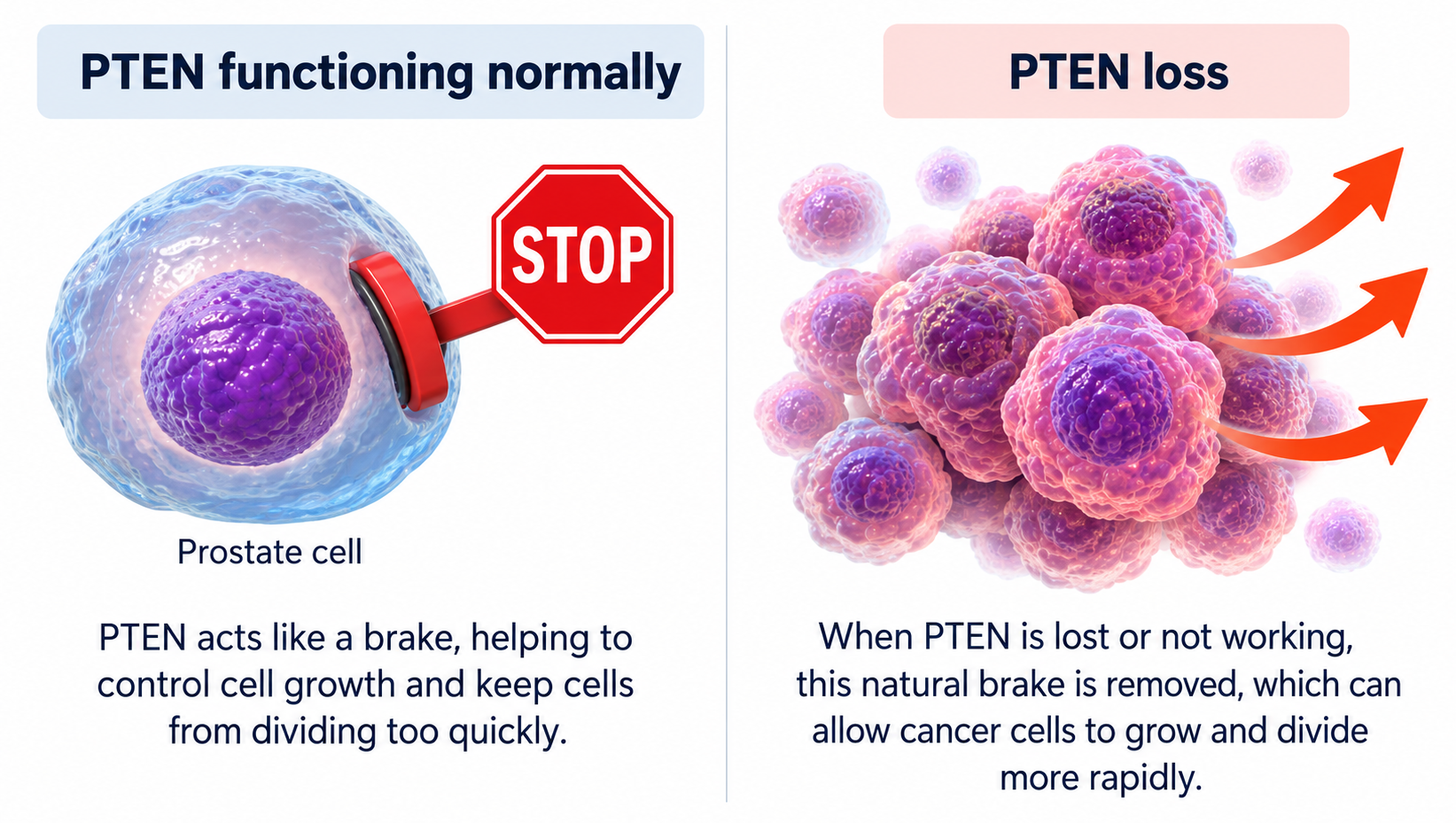
PTEN (pronounced “P-10”) stands for phosphatase and tensin homolog. It’s a gene that helps protect the body against cancer. Everyone is normally born with two copies of PTEN — one inherited from each parent. PTEN acts as a tumor suppressor, essentially serving as a brake that helps keep cells from growing and dividing uncontrollably.
In rare cases, a person may be born with a defective copy of PTEN, which can increase the risk of certain cancers. Being born without any functioning PTEN is believed to be incompatible with normal development. More commonly, however, PTEN can become damaged or stop functioning properly in certain cells during a person’s lifetime. When this happens, the protective brake can fail, allowing cells to grow unchecked — a process that can contribute to cancer development.
Why Does PTEN Matter in Prostate Cancer?
PTEN loss — meaning cancer cells have lost some or all the protective function normally provided by PTEN — isn’t unique to prostate cancer. It can occur in several types of
cancer, including breast, uterine, and brain cancers. However, not all cancers involve PTEN loss. Researchers have found that PTEN loss is relatively common in prostate cancer, particularly in more advanced cases. Studies have linked it to more aggressive tumors, a greater likelihood of cancer progression, and poorer outcomes.
That doesn’t mean, however, that every patient with PTEN loss will develop aggressive prostate cancer. PTEN status is just one piece of the puzzle that doctors may consider alongside PSA levels, Gleason score, cancer stage, and other findings when evaluating a patient’s disease.
How is PTEN Tested?
PTEN testing isn’t routinely performed on prostate cancer patients. It’s generally considered when additional information about a tumor’s biology could help guide treatment decisions, particularly in men with advanced disease.
When testing is appropriate, PTEN status can be evaluated using prostate cancer tissue collected during a biopsy or surgery. One method, called immunohistochemistry (IHC), looks for the PTEN protein in cancer cells. Other tests analyze tumor DNA for changes in the PTEN gene.
Importantly, PTEN loss in a tumor usually develops during a person’s lifetime rather than being inherited. Testing a tumor for PTEN loss is therefore different from testing a person’s blood or saliva for inherited cancer-risk mutations.
Can PTEN Testing Affect Treatment?
Yes — and this is where things get interesting. In June 2026, the FDA approved a targeted drug called capivasertib (Truqap), used with two other medications, for certain men whose prostate cancer has spread beyond the prostate and whose tumors have PTEN loss.
In a major clinical trial, men receiving the new drug combination had a median of 33.2 months before their cancer worsened on imaging or they died, compared with 25.7 months for men receiving the standard treatment combination — a difference of approximately 7.5 months. However, researchers have not yet determined whether the new treatment also helps men live longer.
This new drug combination can also cause significant side effects, including diarrhea, skin rashes, fatigue, and elevated blood sugar, which can be particularly concerning for men with diabetes. Some reactions can be serious and may require treatment adjustments or discontinuation. The combination is approved only for men whose prostate cancer has spread, remains sensitive to hormone therapy, and has confirmed PTEN deficiency. Even among eligible patients, doctors must weigh the potential benefits against the risks and the patient’s overall health.
Should You Be Tested for PTEN?
Not necessarily. PTEN testing isn’t routinely needed for every man diagnosed with prostate cancer. For men with localized disease, treatment decisions are generally based on factors such as PSA levels, Gleason score, and cancer stage rather than PTEN status.
However, for men whose prostate cancer has spread, knowing whether their tumors have PTEN loss may help doctors identify additional treatment options.
Regardless of where you are in your prostate cancer journey, it’s worth asking your physician whether PTEN testing is relevant to your situation and whether the results could influence your treatment options.
What’s Next?
PTEN is just one of many genes researchers are studying to better understand prostate cancer. But recent advances have made it especially important: Doctors can now use PTEN testing to identify certain patients who may benefit from a targeted treatment. It’s another example of how prostate cancer care is becoming more personalized — with treatments increasingly selected according to the unique characteristics of each patient’s cancer.
Next month, we’ll take a closer look at PSMA — a protein that’s changing how doctors detect and treat prostate cancer.

We’ve been publishing BOB Tales for 25 years, sharing thousands of articles—many of which our newer members haven’t seen, and longtime members may have forgotten or would appreciate revisiting. That’s why we regularly reprint articles from past issues that we believe are still relevant and carry an important message. The following is an article from our July 2011 issue.

Can an Alkaline Diet Prevent Cancer?
For years, claims have circulated that making the body more alkaline — or less acidic — can help prevent or even fight cancer. Some have appeared in emails falsely attributed to respected medical institutions, including Johns Hopkins. But is there any truth to these claims?
Supporters of alkaline diets argue that certain foods can change the body’s pH, making it harder for cancer cells to grow. It’s true that some tumors create an acidic environment around themselves. But that doesn’t mean eating alkaline foods can change those conditions or prevent cancer. MD Anderson Cancer Center explains why.
The human body carefully regulates blood pH, normally keeping it within a narrow range of approximately 7.35 to 7.45. The lungs and kidneys work continuously to maintain this balance. Although certain foods can change the acidity of urine, they have little effect on blood pH in healthy individuals.
That doesn’t mean foods promoted as part of an alkaline diet are unhealthy. Many emphasize fruits, vegetables, and other plant-based foods that may help reduce cancer risk and support overall health. But those benefits come from the foods themselves, not from changing the body’s pH. There’s no convincing evidence that an alkaline diet can prevent or treat cancer by altering the body’s acidity.
The message remains as relevant today as when we first published this article: Be skeptical of claims that suggest you can prevent cancer simply by changing your body’s pH.

Heart Trouble or Just Aging? Symptoms Men Shouldn’t Ignore
Feeling unusually tired, getting winded more easily, or experiencing occasional indigestion? These symptoms are often dismissed as normal signs of aging, but they can sometimes indicate an underlying heart problem. Dr. May Bakir, a board-certified cardiologist affiliated with Loyola University Medical Center in Illinois, warns that heart disease doesn’t always produce the classic symptom of chest pain, particularly in older adults.
Other potential warning signs include:
- unexplained sweating
- nausea
- dizziness
- declining stamina
Some heart attacks are even considered “silent,” occurring with mild or unrecognized symptoms. Research has also linked certain physical characteristics, including diagonal earlobe creases and yellowish cholesterol deposits around the eyes, with an increased risk of heart disease, although these features alone don’t indicate a heart condition.
The takeaway? Don’t automatically attribute new or unexplained physical changes to getting older. If you experience possible heart attack symptoms, you should call 911 rather than wait for a routine medical appointment.
New Research Explores a Hidden Driver of Aging
There’s more encouraging news in the fight against Alzheimer’s disease. Researchers at MD Anderson Cancer Center are studying chronic, low-level inflammation that develops
as we age — a process known as “inflammaging”. Evidence suggests this inflammation may contribute to several age-related diseases, including Alzheimer’s and cancer.
Their work focuses on certain aging cells, called “senescent” cells, that can trigger inflammatory responses throughout the body, potentially damaging healthy cells and weakening the immune system over time.
The scientists have also identified a biological pathway that may help drive this process. In preclinical studies, blocking that pathway reduced inflammation and some age-related changes.
Although the research is still early, these discoveries could eventually lead to new ways to control harmful inflammation, promote healthier aging and potentially prevent or treat age-related diseases.
Chopping Wood: A Full-Body Workout
Chopping wood might seem like an old-fashioned chore, but new research suggests it can provide a surprisingly demanding workout. According to researchers, swinging an axe involves far more than arm strength. The movement requires coordinated activity throughout the body, engaging multiple muscle groups while generating considerable force and expending energy.

Researchers found that using a traditional handled axe produced greater ranges of motion and energy expenditure than using certain handheld chopping tools. The findings illustrate how everyday physical tasks can challenge strength, coordination, and stability.
No woodpile? The article also suggests gym exercises that mimic some of these movements, including cable wood chops, medicine-ball throws, and farmer’s carries. Of course, actual wood chopping requires proper technique and physical conditioning to avoid injury.

Gratitude Comes Full Circle
For years, Dennis Hall paid little attention to his annual PSA results. In December 2010, his PSA was 4.08 — just below what he understood to be the upper limit of 4.1 for men his age. But a year later, it jumped nearly three points to 6.88. Even more concerning, his doctor discovered a lump on his prostate during a routine examination.
After several additional PSA tests, Dennis underwent a biopsy in April 2012 — “the most uncomfortable procedure I had ever endured,” he recalls. The results revealed Gleason 7 (4+3) prostate cancer. “The dreaded ‘C’ word,” Dennis remembers. “Both my wife and I were stunned.”
His urologist recommended scheduling robotic surgery within weeks, but Dennis wanted to explore his options first. After meeting with specialists to discuss other treatments, he and his wife were discouraged by the potential side effects. “Needless to say, we were devastated,” Dennis recalls. “Thus began my quest to find a better mouse trap, if one were out there.”
That’s when a former coworker suggested — or, as Dennis puts it, “demanded” — that he investigate proton therapy at Loma Linda University Cancer Center. Dennis subsequently discovered Bob Marckini’s book, You Can Beat Prostate Cancer, which helped convince him that proton therapy might be the answer.
Still, he and his wife wanted to do their due diligence. They traveled to Loma Linda, CA, in June 2012, met with the medical team, toured the facility, and made their decision. Dennis began proton therapy on June 20.
Looking back, Dennis describes his 10 weeks at Loma Linda as “enlightening, enjoyable, entertaining, educational and virtually pain free.” He met “some of the most remarkable people,” explored Southern California, and enjoyed visits with nearby family members and relatives who came to see him.
“I was very pleased with my treatments and just about everything connected to the Loma Linda facilities,” he says. His PSA gradually declined to below 0.1 by 2014, where it remained for years. But his relationship with Loma Linda didn’t end with his final treatment. In many ways, it was just beginning.
Grateful for his outcome and the people who helped make it possible, Dennis became a dedicated supporter of Loma Linda University Health. Through the President’s Club giving program, he’s contributed for years to support the institution and its mission.
Now 81, Dennis remains as committed as ever. In fact, he recently shared that he hopes to increase his charitable giving. Although he expects to transition away from the President’s Club program at the end of the year, he plans to continue supporting Loma Linda through annual gifts made directly from his IRA — a tax-smart approach that allows eligible charitable donations to be excluded from his taxable income.
Dennis’ generosity extends beyond proton therapy. He intends to continue dividing his contributions among proton research, Loma Linda’s broader cancer care initiatives, and Loma Linda University Children’s Hospital. For him, giving back is a way to express gratitude while helping to ensure that others have access to the kind of exceptional care he received.
Dennis certainly isn’t slowing down. He still maintains his large property in Spokane, WA, including 1.5 acres of manicured lawn, handling about 95 percent of the work himself. He enjoys traveling, reading, cheering on the Seattle Seahawks, spending time with family, and his prized 1957 Chevy Nomad.

More than 14 years after his prostate cancer diagnosis, Dennis remains deeply appreciative of the treatment he received and the people who cared for him. And through his continued generosity, he’s helping make a difference in the lives of others — a fitting way to give back to the institution that made such a difference in his life.

Giving Options
Make a gift online and choose where you'd like it to go:
- Cancer Center Vision / Stronger Together Campaign
- Proton Research – James M. Slater Chair
- Proton Research – Robert J. Marckini Chair
- Other (specify area or write “unrestricted” for area of greatest need)
Send a check to “LLUCC.” Specify where you’d like to direct your gift in the memo line and mail to: LLUH Office of Philanthropy | P.O. Box 2000 | Loma Linda, CA 92354
Call 909-558-5010 to make a gift or ask questions.


Do You Remember Reading Bob’s Book?
For many BOB members, You Can Beat Prostate Cancer arrived at a time when they were facing one of the most difficult decisions of their lives. Some discovered it through a friend or family member. Others stumbled upon it while searching for information after their diagnosis. One member told us he found a copy in his dentist’s office!
Now we’d love to hear your story.
How did you first hear about Bob’s book? Where were you in your prostate cancer journey when you read it? Did anything in particular stand out, surprise you, or influence your treatment decision? And looking back, what would you tell someone picking it up for the first time today?
Whether you read the first edition 20 years ago or the second edition more recently, we’d love to hear your personal reflections. Your experience might even inspire a future BOB newsletter feature!
We can't wait to hear from you! Just click the button below.


Last Month’s Brain Teaser
How many people need to be in a room before there’s a greater than 50% chance that at least two of them share a birthday?
Answer: 23 people! With just 23 people in a room, there’s a 50.7% chance that at least two share a birthday. It’s called the “Birthday Paradox,” and the answer surprises most people because they expect the number to be much higher!
Congratulations to Mike Mulcahy of Shawnee, KS! Mike was treated for prostate cancer with proton therapy in 2012 at ProCure Proton Therapy Center (now Oklahoma Proton Center) in Oklahoma City, OK. He reports that his overall health is good and continues to stay active, including playing golf regularly. A Vietnam veteran who served in the Marine Corps, Mike is also involved with Folds of Honor, an organization that provides educational scholarships to military and first responder families. He and his wife, Carol, enjoy attending the symphony and visiting Yellowstone and Grand Teton national parks. A strong supporter of proton therapy, Mike says he recommends it to anyone who will listen. And judging by his T-shirt, Mike certainly knows how to enjoy life!

New Brain Teaser
There are 30 sharks in a pond. 28 dolphins. How many didn’t?
Send us your answer for a chance to win a signed copy of Bob Marckini's second edition of You Can Beat Prostate Cancer — plus a BOB T-shirt!
Hint: A play on words?

The Haircut

A teenage boy had just passed his driving test and couldn’t wait to get behind the wheel of the family car.
“Dad, when can I start borrowing the car?”
His father thought for a moment. “I’ll make you a deal. Bring your grades up from a C to a B average, study your Bible, and get a haircut. Do all three, and we’ll talk.”
Six weeks later, his father called him into the living room.
“Son, I’m proud of you. Your grades are up, and I can see you’ve been reading your Bible. But you still haven’t gotten that haircut.”
“Well, Dad,” the boy replied, “I’ve been doing a lot of Bible study, and I noticed something interesting. Samson had long hair. John the Baptist had long hair. Moses had long hair. And even Jesus had long hair!”
His father smiled.
“That’s true, son. They also all walked everywhere they went.”
Old is Just Old… Not Stupid
A young construction worker was constantly bragging about his strength, claiming he could lift more, carry more, and work harder than anyone on the job site. He especially enjoyed teasing one of the older workers.
Finally, the older man had enough.
“I’ll bet you a week’s wages I can push something in the wheelbarrow over to that building that you won’t be able to push back.”

The young man laughed. “You’re on, old-timer! Let’s see what you’ve got!”
The older man grabbed the wheelbarrow, positioned it in front of him, and smiled.
“Hop in.”

Has Noah’s Ark Been Found?
For decades, a strange boat-shaped formation in eastern Turkey has fueled speculation that it could be connected to the biblical story of Noah’s Ark. Researchers are actually drilling into it — and they’ve already encountered a surprise.
The Durupınar formation, located about 18 miles south of Mount Ararat, is roughly 515 feet long and bears a striking resemblance to the outline of a ship. Most geologists who’ve studied the site have considered it a natural geological formation, but recent underground scans have renewed interest in what might lie beneath it.
Ground-penetrating radar and other imaging conducted at the site have revealed unusual underground features that researchers describe as corridor-like structures, angular formations and a large central area they’ve dubbed an “atrium.” The scans alone can’t determine whether those features are natural or man-made.
During drilling last month, the team encountered an unexpectedly hard layer several feet below the surface — hard enough to damage the drill bit. Researchers have raised the possibility that the material could be petrified wood, but laboratory testing will be needed to determine exactly what it is.
Researchers have now reportedly sent a small camera-equipped robot about 40 feet underground and collected hundreds of samples for laboratory analysis.
Have they found Noah’s Ark? No one knows — not yet, anyway. But after decades of speculation about what’s underneath this peculiar boat-shaped patch of earth, scientists may finally be getting some answers.
A Giant Jellyfish in the Sky?

Early risers across parts of the eastern United States witnessed an extraordinary sight on October 13 — a massive, glowing “space jellyfish” floating across the morning sky! The unusual formation appeared shortly after a SpaceX Falcon 9 rocket launched from Cape Canaveral, Florida, carrying more than 6,300 pounds of supplies and scientific equipment to the International Space Station.
The spectacular display occurred when the rocket’s exhaust expanded high into the thin atmosphere and caught the rays of the rising sun, creating an enormous, illuminated cloud resembling a jellyfish. This phenomenon occurs during launches shortly before sunrise or after sunset, when the sky is still dark but sunlight reaches the rocket’s exhaust high above Earth.

Thank You to the BOB Family
Every November, Thanksgiving gives us an opportunity to reflect on the many people who’ve made the Brotherhood of the Balloon so much more than a prostate cancer support organization.
When the BOB began more than two decades ago, our mission was simple: Help men facing prostate cancer learn about proton therapy and make informed treatment decisions.
We could never have imagined the extraordinary community that would grow from that mission.
Today, thousands of men who once faced the uncertainty of a cancer diagnosis are helping others navigate that same difficult journey. Many of you volunteer to share your experiences with newly diagnosed men through our patient reference lists. Others forward our newsletter, recommend and even hand out Bob’s book, make generous contributions to support cancer research, speak up when policies threaten access to proton therapy, or simply take a few minutes to offer encouragement to someone who needs it.
What makes this especially remarkable is that many of you completed treatment 10, 15, or even 20 years ago. You could have moved on and left prostate cancer behind. Instead, you’ve chosen to remain connected and help others.
That generosity is something we never take for granted.
We’re also deeply grateful to Loma Linda University Health, which pioneered the use of proton therapy in a hospital setting and whose ongoing support provides us with the resources to continue our mission. We extend that gratitude to the physicians, nurses, researchers, and other dedicated professionals at Loma Linda and proton therapy centers around the world, as well as the National Association for Proton Therapy, for their tireless efforts to advance cancer treatment, protect patient access, and improve quality of life. We’re equally thankful for those who helped establish the BOB in its earliest days and those who continue working behind the scenes to keep our newsletter and mission going strong. Their commitment, expertise, and partnership make our work possible.
We’d like to express special gratitude to Dr. J. Lynn Martell, who was the first person at Loma Linda University Health to recognize the value and potential of the Brotherhood of the Balloon — even before we fully recognized it ourselves. His early belief in our mission, encouragement, and steadfast support helped the BOB grow into the organization it is today. During this season of Thanksgiving, we’re especially grateful for his friendship, his confidence in what we were building, and all he has done over the years to help us reach and support men facing prostate cancer.
And to our faithful BOB members, especially those who take the time to write to us — whether to share a personal update, ask a question, send a joke, or simply say hello — please know how much those connections mean to us. They remind us that behind every diagnosis, every treatment decision, and every statistic is a person with a life, a family, and a story worth hearing.

To every member of our BOB family, thank you for being part of something so special. We wish you and your loved ones a wonderful Thanksgiving filled with good health, happiness, and plenty of reasons to be grateful.
Happy Thanksgiving and low PSAs to all,
Bob Marckini and Deb Hickey
Want a printable version of this issue?
👉 Download the PDF here.
NO MEDICAL ADVICE: Material appearing here represents opinions offered by non-medically trained laypersons. Comments shown here should NEVER be interpreted as specific medical advice and must be used only as background information when consulting with a qualified medical professional.